





Aquarium Foam Filters and Pond Foam Filters
UK's largest aquarium filtration foam (PPI foam) supplier
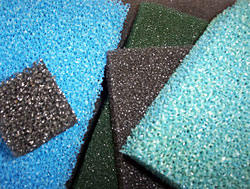
Reticulated polyether foam, also known as PPI Foam or Filter foam, is an open-cell polyether-based polyurethane foam, used predominantly for pond and aquaria filtration. Polyether is chemically stable in non-neutral aqueous conditions.
PPI, which stands for 'Pores per Inch', indicates the number of holes/cells per inch of filter foam. Efoam supplies various reticulated foams from 10ppi to 45ppi. 10ppi has the largest sized cells, and the lowest quantity of cells per inch, whereas 45ppi, has the smallest cells but a much higher number of cells per inch. 10ppi filter foam will provide a higher flow while a 45ppi has a lower flow.
The filter is the life support of a tank or pond; a healthy filter means healthy fish. The reticulated foam serves a variety of essential functions which include protecting the pump from debris, breaking down dissolved fish bio-waste thus reducing nutrients that promote algae growth and aiding entrapment of smaller suspended particulates.
Click to view the PPI foam datasheets. 10PPI 20PPI 30PP 40PPI
Benefits of Reticulated Filter Foam for Aquariums and Ponds
Reticulated polyether foam has excellent resistance to water (including saltwater), humidity, soap, oils and lubricants. Swelling may occur in the presence of organic solvents depending on the type and concentration. In biotechnological water purification applications, filter foam is the ideal material to act as a carrier of bacteria and to improve the active surface efficiency of the bioreactor.
Key advantages of using PPI filter foam:
- Superior biological filtration: The open-cell structure provides enormous surface area for beneficial bacteria colonization, essential for breaking down toxic ammonia and nitrites
- Mechanical filtration: Effectively traps debris, fish waste, and suspended particles while maintaining excellent water flow
- Chemical stability: Polyether foam won't degrade in water and is resistant to pH variations, making it ideal for both freshwater and saltwater applications
- Long-lasting durability: Unlike foam filters that break down quickly, reticulated foam maintains its structure for years with proper maintenance
- Easy maintenance: Simply rinse in pond water or dechlorinated water to clean - no need for frequent replacements
- Cost-effective: One-time purchase provides years of reliable filtration, far more economical than disposable filter cartridges
Choosing the Right PPI Grade for Your Application
10PPI (Coarsest) - Best for:
- Pre-filtration in multi-stage filter systems
- Large koi ponds with heavy debris loads
- Pump protection from leaves and large particles
- Maximum water flow applications
- First stage in gravity-fed pond filters
20PPI (Medium-Coarse) - Best for:
- General koi pond filtration
- Large aquariums (200+ litres)
- Garden pond filters and water features
- Secondary filtration stage
- Balance between flow rate and filtration efficiency
30PPI (Medium-Fine) - Best for:
- Tropical and coldwater aquariums
- Fine mechanical filtration
- Crystal-clear water applications
- Marine aquarium sumps
- Tertiary filtration stage
40PPI (Finest) - Best for:
- Final polishing stage for ultra-clear water
- Small nano aquariums
- Shrimp tanks and breeding setups
- Maximum particle capture
- Applications where water clarity is critical
Popular Use Cases and Applications
Koi Ponds: Our filter foam is extensively used in koi pond filtration systems. The 20PPI grade in 25mm or 50mm thickness is the most popular choice, providing excellent mechanical and biological filtration while handling the heavy bioload from koi fish.
Aquarium Filters: Perfect for internal and external aquarium filters, canister filters, and sump systems. The foam's open structure allows beneficial bacteria to thrive, creating a stable and healthy aquarium environment.
Garden Pond Filters: Ideal for gravity-fed pond filters, pressurized bead filters, and DIY pond filtration systems. The durability and water resistance make it perfect for outdoor applications.
Water Features: Protects pumps in fountains, waterfalls, and ornamental water features from debris while maintaining optimal flow rates.
Commercial Aquaculture: Used in fish farms and commercial breeding facilities for cost-effective, large-scale biological and mechanical filtration.
Hydroponics: Acts as a growing medium and biofilter in hydroponic and aquaponic systems, supporting plant roots while filtering water.
How to Choose the Right Size and Thickness
Sheet Sizes:
- 200 x 100cm (Full Sheet): Best value for large ponds, multiple filter boxes, or if you need to cut custom shapes. Ideal for commercial applications or maintaining multiple systems
- 100 x 100cm (Half Sheet): Perfect for single pond filters, large aquarium sumps, or gravity-fed box filters. Most popular size for domestic koi ponds
- 50 x 50cm (Quarter Sheet): Ideal for aquarium filters, small pond filters, or replacement foam for existing systems. Great for trying different PPI grades
Thickness Selection:
- 12mm: Compact aquarium filters, space-limited applications, or where multiple thin layers are preferred for staged filtration
- 25mm: Most versatile thickness suitable for 90% of applications. Provides excellent filtration capacity without excessive depth
- 50mm: Heavy bioload systems, large koi ponds, or where maximum biological filtration is required. Provides twice the bacteria colonization area of 25mm
- 75mm: Ideal for large gravity-fed koi pond filter boxes and multi-chamber systems where maximum biological filtration depth is needed. Popular with serious koi keepers building their own filter systems
- 100mm: Our deepest option, suited to commercial aquaculture, large-scale koi systems and serious DIY filter builds. Provides the greatest bacteria colonization area and maximum biological filtration capacity
Maintenance and Care Instructions
Cleaning Your Filter Foam: Never clean filter foam under tap water as chlorine kills beneficial bacteria. Instead, squeeze and rinse the foam in a bucket of pond water or dechlorinated water. Clean when water flow noticeably decreases, typically every 2-4 weeks depending on bioload.
When to Replace: Quality reticulated foam can last 5-10 years or more. Replace only when the foam begins to tear, loses elasticity, or starts to break apart. Regular cleaning extends foam life significantly.
Multiple Foam Strategy: Many advanced aquarists use different PPI grades in layers - coarse foam first (10-20PPI) for mechanical filtration, followed by finer grades (30-40PPI) for polishing, maximizing both flow and filtration efficiency.
Technical Specifications
Material: Reticulated polyether-based polyurethane foam (open-cell structure)
Density: Approximately 28-30 kg/m³
Temperature Range: -20°C to +70°C
pH Stability: Stable from pH 4 to pH 11
Water Absorption: Excellent (polyether type)
Chemical Resistance: Resistant to water, oils, lubricants, mild acids and alkalis
Colour: Varies depending on PPI & availability. Colour does not affect the performance or quality of the foam.
Cell Structure: 100% open-cell reticulated
Efoam can supply reticulated polyether foam for commercial and non-commercial applications. For further information on reticulated filter foam, please see our aquatic filter foam guide.
Should you wish to discuss your requirements, please feel free to contact us, and we will be more than happy to assist.