





UK Foam Grades, Types & Datasheets — Reflex, Memory, Reconstituted, Pyrosorb, Plastazote and more
Every grade we cut, with downloadable datasheets — from the UK's largest online foam manufacturer, for over 40 years
Most foam choices come down to one question: what will the foam actually do? A cushion that sits on a sofa for ten years takes a different grade from one that sits in a campervan getting rained on, or a pad an elderly Labrador sleeps on every night, or a sheet of foam protecting a sound desk from echoes. We stock the full UK range and have done for over 40 years, with every grade backed by a downloadable datasheet you can hand to your upholsterer, architect, or building control if needed.
Below you'll find every grade we cut, grouped by what it's made of and what it does. If you know exactly what you need, the table is yours: every row has a datasheet, a link to the relevant product page, and notes on what it's typically used for. If you're not sure, use the Find Your Foam tool just below: select what you're making or repairing, and we'll highlight the grade generally recommended.
General guidance for typical UK domestic use. For commercial premises, contract sales, regulated applications, or unusual conditions please contact our technical team for advice tailored to your specific situation.
Quick guide: which foam for which job?
A condensed reference for the most common UK use cases. The grade we recommend is what UK trade and retail buyers most often choose after we've worked through their job over the phone. Use the Find Your Foam tool above for an interactive version that highlights the grade in the full table below.
| What you're making or replacing | Recommended grade | Notes |
|---|---|---|
| Home furniture & bedding | ||
| Sofa / armchair cushions (3-5" thick) | High Firm (SF38) | UK trade default. Significantly longer service life than standard polyether. |
| Bed mattress | Reflex Superior Foam + Memory topper | Most popular spec. 8-12 years life. |
| Dining chair / kitchen seat | Severe (SF50) for thin, High Firm for thicker | Density matters for chair-height comfort. |
| Window seat cushion | Severe (SF50) for thin (1-3"); High Firm (SF38) for 4"+ banquette | Thin profile needs density. |
| Headboard | Average Soft (SF21) | Not for seating. Soft enough for hand contact. |
| Vehicles, narrowboats & motorhomes | ||
| Campervan Rock & Roll bed (VW T-series) | Reflex Superior Firm or High Firm | Double-duty seat + bed. See campervan cushions. |
| Narrowboat saloon bench / Pullman dinette | High Firm (SF38) | Bench by day, bed by night. See narrowboat cushions. |
| Static caravan mattress | Reflex Medium + memory topper | Guest review territory. See static caravan cushions. |
| Classic car seat restoration | Severe (SF50) for period correctness | Modern soft foam is wrong density. |
| Pet beds | ||
| Small dog or cat bed (under 15kg) | Reflex Medium | Light enough to lift for washing. |
| Medium-to-large dog bed (Labrador, spaniel) | High Firm (SF38) | See dog and pet bed foam. |
| Older or arthritic dog bed | Memory foam topper + High Firm base | Joint relief without sinking too far. |
| Outdoor kennel bed | Reticulated water-drain (aquatic filter) | Water passes through, dries in hours. |
| Public & commercial | ||
| Church pew / kneeler / hassock | Reconstituted chip (SFR6 or SFR9) | Lasts 20+ years. See church pew cushions. |
| Bar stool / pub seating | Reconstituted chip (SFR9) | Heavy commercial wear. |
| Cinema / theatre / hotel lobby | Pyrosorb-S Class 0 | Fire compliance is critical. |
| Office chair seat refoam | Severe or High Firm | Density matters more than depth. |
| Wheelchair cushion | Reconstituted chip (SFR9) | Pressure tolerance + longevity. |
| Outdoor & garden | ||
| Garden furniture cushion / rattan sofa | Reticulated water-drain | See garden furniture cushions. |
| Sun lounger cushion | Reticulated water-drain | Same grade as filter foam. |
| Specialist applications | ||
| Cot mattress / Moses basket | Cot safe (SF28CS) | Free of antimony, arsenic, PBDEs, CFCs. |
| Recording studio acoustic panels | Acoustic foam (PHOE25) | Reduces reverberation and echoes. |
| Electronics packaging | Antistatic pink (AS22) | ESD protection. |
| Flight case / heavy packaging | HLB Packaging (SF22P) or Ethafoam | Choose by weight of contents. |
| Cosplay / costume building | Plastazote (LD33 / LD45) | Cuttable, lightweight, 10 colours. |
| Aquarium / pond filter | Reticulated PPI foam | Choose by PPI rating. |
| Gasket / door seal | EPDM Sponge Rubber | Weatherproof, self-adhesive option. |
Foam terminology — quick definitions
The acronyms and jargon you'll see across the grades below.
- PU
- — Polyurethane. The open-cell foam family used for cushions, mattresses and pet beds. Soft, springy, breathable.
- PE
- — Polyethylene. The closed-cell foam family used for packaging, insulation and outdoor applications. Firm, waterproof.
- CMHR
- — Combustion Modified High Resilience. Fire-treated foam meeting UK Furniture and Furnishings (Fire) (Safety) Regulations 1988.
- HR
- — High Resilience. Premium polyurethane with better recovery and longer life than standard PU.
- Class 0
- — UK fire rating for surface spread of flame to BS 476 Parts 6 & 7. Required for commercial premises.
- BS 5852
- — British Standard covering ignitability of upholstered seating. Tests for cigarette and match resistance.
- ILD / IFD
- — Indentation Load Deflection / Indentation Force Deflection. Measures how much force in Newtons is needed to compress the foam by 25 percent. Indicates firmness.
- PPI
- — Pores Per Inch. Used to specify reticulated filter foam. Higher PPI means finer pores (more filtration).
- ESD
- — Electro-Static Dissipation. Antistatic foam (pink) used to package sensitive electronics.
- FR
- — Fire Retardant treated. A grade variant with additives to slow ignition.
- Reticulated
- — foam where the cell walls have been removed leaving an open mesh. Used for filtration and outdoor cushions (water drains straight through).
- Open-cell
- — foam with interconnected cells. Air passes through. Soft and comfortable. All PU grades are open-cell.
- Closed-cell
- — foam with sealed cells. Water and air cannot pass through. Firm and water-resistant. All PE grades are closed-cell.
- Density
- — kg per cubic metre. How much material is packed into the foam. Higher density usually means longer life.
- Firmness
- — how much force it takes to compress the foam. Determines what the cushion feels like to sit on. Not the same as density.
Technical specifications — density, firmness and lifespan
The numerical specifications for each foam grade. Density indicates how much material is packed in (longer life). Firmness is given as Indentation Force Deflection (IFD) in Newtons for seating-grade polyurethane foams, as compression deflection in kPa for closed-cell foams that publish it, or as a descriptive rating where neither applies. Lifespan is typical UK domestic use.
| Grade | Foam family | Density | Firmness | Typical lifespan |
|---|---|---|---|---|
| Polyurethane seating grades (PU, open-cell) | ||||
| SF21 | Average soft foam | 22-24 kg/m³ | 86-110 N | 1-2 years (not a seating grade) |
| SF25/140 | Gym pit foam, Value grade | 22.8-25.2 kg/m³ | 125-145 N | 3-5 years |
| SF33 | Medium foam | 31-34 kg/m³ | 100-130 N | 4-6 years |
| SF33/190 | Gym pit foam, Premium grade | 31.4-34.6 kg/m³ | 175-210 N | 6-10 years |
| SF38 | High firm foam | 38-40 kg/m³ | 180-220 N | 5-8 years |
| SF50 | Severe very firm foam | 48-52 kg/m³ | 225-265 N | 8-12 years |
| Reflex400 | Reflex Superior Medium | 40 kg/m³ | 130 N | 5-8 years |
| Reflex400H | Reflex Superior Firm | 40 kg/m³ | 160 N | 6-10 years |
| SF50M | Memory Foam | 50 kg/m³ | 90 N | 5-8 years |
| Polyurethane specialty grades | ||||
| SF28CS | Cot safe foam | 28 kg/m³ | 120 N | 3-5 years |
| SF22P | HLB Packaging foam | 22 kg/m³ | 90 N | 2-3 years |
| AS22 | Antistatic pink (ESD) | 22 kg/m³ | Soft (light packaging) | 10+ years |
| PHOE25 | Acoustic foam | 25 kg/m³ | Soft (open-cell acoustic) | 10-15 years |
| Pyrosorb-S | Class 0 acoustic | Varies by spec | Medium (open-cell acoustic, Class 0) | 10-15 years |
| Reconstituted chip foam (densest seating grade) | ||||
| SFR6 | Reconstituted chip 6 | 96 kg/m³ (6 lb/ft³) | Very firm (densest seating) | 20+ years |
| SFR9 | Reconstituted chip 9 (denser) | 144 kg/m³ (9 lb/ft³) | Extremely firm (densest grade) | 25+ years |
| Polyethylene closed-cell foams (PE, packaging & outdoor) | ||||
| LD33 | Plastazote LD33 | 33 kg/m³ | 69 kPa at 25% (BS ISO 7214) | 15+ years |
| LD45 | Plastazote LD45 | 45 kg/m³ | 94 kPa at 25% (BS ISO 7214) | 15+ years |
| EFP30 | Closed cell PE | 30 kg/m³ | 62 kPa at 25% (ISO 844) | 10+ years |
| EFP45 | Closed cell PE (denser) | 45 kg/m³ | 100 kPa at 25% (ISO 844) | 10+ years |
| Ethafoam | Semi-rigid PE packaging | Varies by grade | Semi-rigid (packaging) | 10+ years |
| Synthetic rubber | ||||
| EPDM | EPDM Sponge Rubber | 90-140 kg/m³ | 20-50 kPa at 25% (ASTM D1056) | 20+ years |
| Reticulated open-cell foam (filtration & drainage) | ||||
| 10 / 20 / 30 / 40 PPI | Aquatic filter / reticulated polyether | 28-30 kg/m³ | Soft (open-mesh reticulated) | 5-10 years (submerged use) |
A few notes on this table: Accessories (yoga rollers, wrap rolls, adhesives) aren't shown in this technical table. SF33 and SF33/190 are the same foam ordered to two firmnesses, which is why they share a density and a datasheet. Lifespan figures are indicative typical values for normal UK domestic use and are not guarantees. Actual service life will vary with user weight, frequency of use, environmental conditions (temperature, humidity, UV exposure, water contact) and care. Packaging and protective foams may last considerably longer in static applications, or shorter under heavy daily compression cycles. For commercial, contract or regulated applications please contact our technical team for specification advice. IFD is "—" where the foam isn't a seating grade and therefore isn't tested for indentation force.
Full Foam Grade List with Datasheets
Click any row image or heading to go to that grade's product page. Click the datasheet link to download the PDF spec sheet.
| Open-cell Polyurethane Foams (cushions, mattresses, seating) | |
 |
Average soft foam - SF21 soft foam datasheetLight density foam suitable for headboards and general use. We do not recommend this grade for any seating application; it compresses flat within 12 to 24 months under repeated use. |
|---|---|
 |
Medium foam - SF33 medium foam datasheetMedium density foam suitable for domestic seating cushions of 5" (12.7cm) or more in thickness. An ideal replacement for fibre-filled cushions, and often used as the inner core in deeper sofa cushions with a firmer top layer. |
 |
High firm foam - SF38 high firm foam datasheetHigh density quality seating grade and the UK trade default. Suitable for sofa and armchair cushions, dog and other pet beds, VW Camper foam, campervan cushions, narrowboat saloon benches, static caravan lounges, pallet furniture and many more. Suitable for thicknesses between 3" and 5" (7.5-12.7cm). By far the most popular grade of foam in the UK. |
|
Severe very firm foam - SF50 very firm foam datasheetVery high density seating grade foam suitable for foam cushions less than 3" (7.5cm) in thickness. Suitable uses include window seat cushions, quality dining chairs, kitchen seats, office chair seat refoams, and vehicle restoration projects where period-correct density matters. |
 |
Reconstituted super firm chip foam - SFR6 recon foam datasheet - SFR9 recon foam datasheetReconstituted chip foam (commonly called Recon foam) is a contract seating foam used for wheelchair seats, church pew cushions and kneelers, bar seating, bar stools, pub and restaurant seating, and many packaging applications. Available in 6 pound (SFR6) or denser 9 pound (SFR9). The densest foam we stock; lasts 20+ years in heavy commercial use. |
 |
Reflex Superior medium foam - Reflex400 medium foam datasheetBranded premium foam. The ultimate in comfort and durability with instant recovery after use and consistent shape retention over many years. Excellent for armchair and settee cushions and as a mattress core without bonding different foams. Used in motorhome and touring caravan refits and small dog beds. |
 |
Reflex Superior firm foam - Reflex400H firm foam datasheetSame as Reflex Medium but firmer. The premium choice for campervan Rock & Roll beds that get used as both seating and sleeping, and for any cushion where compression cycles run into the thousands per year. |
 |
Memory Foam - SF50M memory foam datasheetAt room temperature memory foam is harder than at skin temperature, which causes it to soften on contact and mould to the shape of a warm body within a few minutes. Excellent for mattress toppers, pillows, and orthopaedic dog beds. Best paired with a firmer base layer rather than used alone; pure memory foam allows heavier sleepers to sink too far. |
 |
Random foamOffcuts and fabricated (glued) pieces from production. Could be any grade. Useful for non-specific projects, prototypes, model-making, casting moulds and other applications where the foam grade doesn't matter. We do not recommend this for any specific application. |
 |
Cot safe foam - SF28CS cot safe foam datasheet - Cot mattress further informationSoft-medium density foam specifically formulated for cot mattresses and Moses baskets, not suitable for seating. Free from antimony, arsenic, phosphorus, PBDEs and chlorofluorocarbons (CFCs). Compliant with UK safety standards for infant sleeping products. |
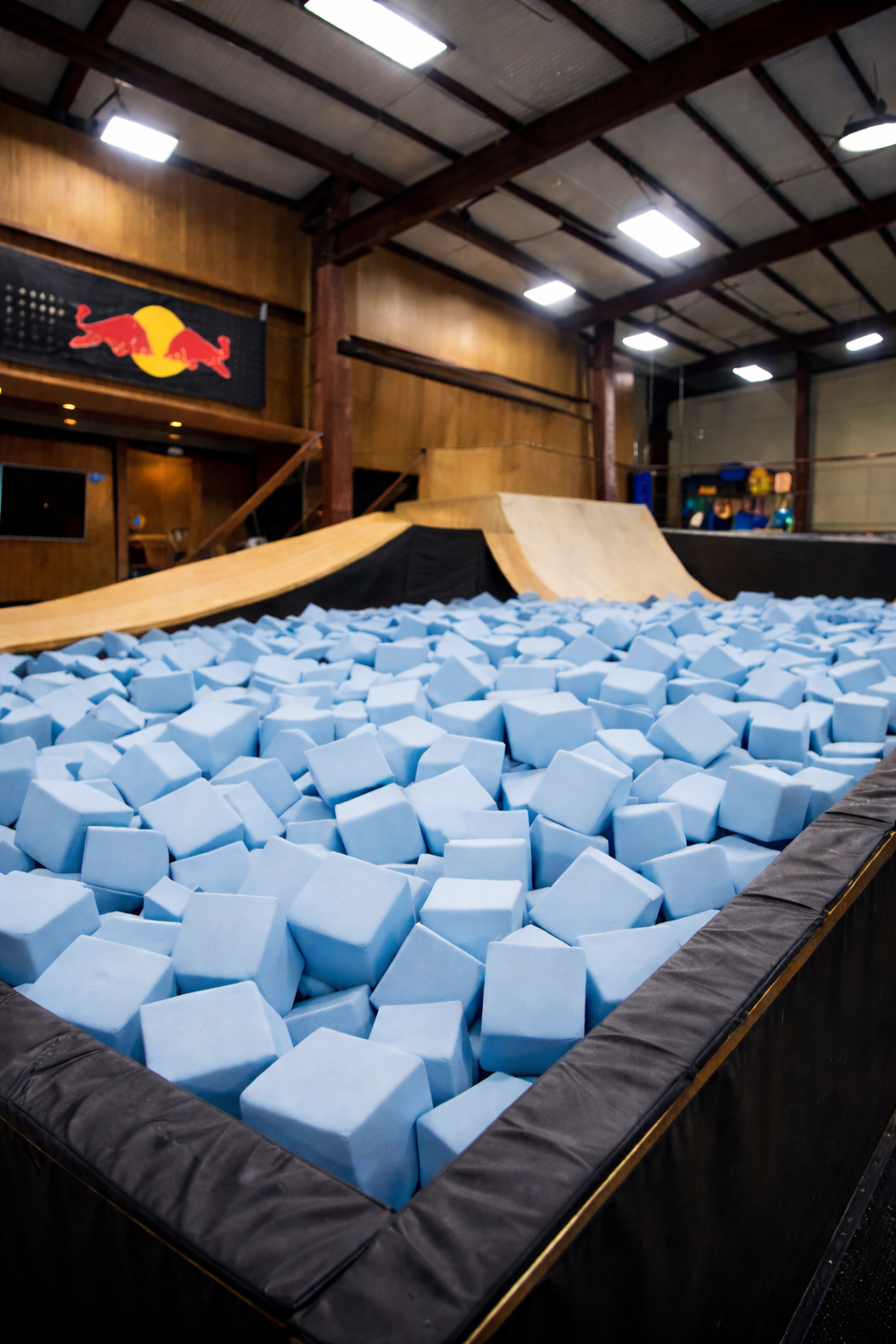 |
Gym pit foam cubes, blocks & logs - SF38 - SF33/190 - SF33 - SF25/140Loose fill for gymnastics, trampoline park, BMX, motorcycle and skate landing pits, supplied as 15cm and 20cm cubes and as 50cm and 60cm logs. Four grades: Competition (Blue) SF38 at 38-40 kg/m³ and 180-220 N, the densest gym pit foam on the UK market; Premium (Pink) SF33 ordered firm at 31.4-34.6 kg/m³ and 175-210 N; Standard (Green) SF33 at 31-34 kg/m³ and 100-130 N; and Value (Grey) SF25/140 at 22.8-25.2 kg/m³ and 125-145 N. Use our free gym pit foam calculator to work out quantities and price, with free mainland UK delivery. |
| Closed-cell Polyethylene Foams (packaging, insulation, outdoor) | |
 |
EFP30 Closed cell polyethylene foam - EFP30 closed cell datasheet - EFP30 FR fire retardant datasheetBlack or white rigid closed cell foam, non-absorbent and waterproof, supplied in sheets of various thicknesses. Polyethylene foam is rigid and perfectly suited for industrial and commercial packaging, flotation aids and insulation applications. FR (fire retardant) variant available. |
|
EFP45 Closed cell polyethylene foam (denser) - EFP45 closed cell datasheetBlack rigid closed cell foam, more rigid and denser than EFP30, non-absorbent and waterproof, supplied in sheets of various thicknesses. Specified where higher load-bearing or impact resistance is required for industrial and commercial packaging applications. |
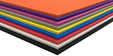 |
Zotefoam Plastazote® superior closed cell foam - LD33 datasheet - LD45 datasheetNitrogen expanded cross-linked closed cell foam in 10 colours and various thicknesses, non-absorbent and waterproof. With or without self-adhesive backing. The go-to choice for cosplay armour, theatre props, model-making, lightweight buoyancy, packaging and insulation. We also supply high density EVA Yoga foam rollers. |
 |
Ethafoam semi-rigid packaging foam - Ethafoam / Stratocell datasheetWhite medium density non cross-linked expanded polyethylene supplied in sheets of various thicknesses. Perfectly suited for packaging medium and heavy items in transit, particularly where impact resistance is needed over many uses. |
 |
EPDM Sponge Rubber foam - EPDM Sponge Rubber datasheetFlexible expanded closed cell synthetic rubber used for gaskets, door seals, weatherstripping, packaging, transportation, and construction. With or without self-adhesive backing. Stays flexible across a wide temperature range. |
| Specialist & Fire-Rated Foams | |
 |
HLB Packaging foam - SF22P HLB packaging foam datasheetHLB (High Load Bearing) high impact light weight packaging grade foam, charcoal grey in colour. Suitable for protective packaging applications including flight cases, briefcases, tool cases, cardboard box inserts, and equipment transport. |
 |
Antistatic pink foam (ESD) - AS22 antistatic ESD datasheetAnti-static open cell polyurethane foam, used for packaging sensitive electronics. Also known as ESD foam (Electro-Static Dissipation). The signature pink colour identifies it instantly as the right grade for circuit boards, sensitive components and electronic assemblies. |
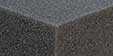 |
Acoustic foam (PHOE25) - PHOE25 acoustic foam datasheetAcoustic treatment and soundproofing foam, charcoal grey in colour. Significantly reduces reverberation, reflections and flutter echoes in recording studios, home cinemas and rehearsal rooms. Sold in sheets, cut to size or as ready-made tiles. |
 |
Pyrosorb-S Class 0 Acoustic Foam - Pyrosorb-S datasheetClass "0" accredited cellular acoustic foam. Flexible, non-irritant, safe and easy to install with self-adhesive backing. The certificate-backed grade specified for cinemas, theatres, hotels, restaurants and any commercial premises where fire compliance is non-negotiable. |
 |
Aquatic filter / reticulated water-drain foam - 10PPI - 20PPI - 30PPI - 40PPIReticulated polyether foam, available in 10, 20, 30 and 40 PPI (pores per inch). Used for pond and aquaria filtration in fresh and salt water. The same open-structure grade also drains water freely, making it the right choice for garden furniture cushions, sun loungers and outdoor pet beds. |
| Accessories & Tools | |
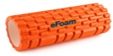 |
EVA Yoga foam rollersHigh Quality, high density foam rollers made from EVA foam with a strong PVC internal pipe. Perfect for Yoga, Pilates, balancing, stretches, physical therapy, massage therapy and sports-related training. Available in multiple lengths and colours. |
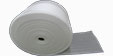 |
Packing foam wrap rollsIdeal for protecting items in transit or storage. Wraps around delicate items to prevent scuffs, scratches and abrasion damage. Sold by the roll in standard widths. |
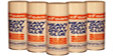 |
eFoam heavy duty spray adhesive - Spray adhesive datasheetExceptionally powerful contact adhesive in a convenient aerosol. Bonds foam to foam, foam to fabric, and foam to wood / MDF. The trade-grade glue we use in our own workshop when bonding memory foam toppers to firmer bases. |
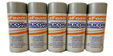 |
High performance silicone spray lubricant - Silicone spray datasheetHigh performance multi-purpose silicone spray lubricant, 500ml. Useful when refitting foam cushions into tight covers (a light spray on the inside of the cover lets the foam slide in without bunching). |
How to Choose: Open-Cell vs Closed-Cell, Density vs Firmness
Open-cell vs Closed-cell: Polyurethane foams (Average, Medium, High Firm, Severe, Reflex, Memory, Cot Safe) are open-cell foams, the bubbles inside are interconnected, so air passes through. That's what makes them soft, springy and comfortable. Polyethylene foams (Plastazote, Ethafoam, EFP30, EFP45) are closed-cell foams, each bubble is sealed. That's what makes them firmer, water-resistant and durable in commercial and industrial use. Neither is "better"; they do different jobs.
Density vs Firmness: These are different properties that are often confused. Density (kg per cubic metre) is how much material is packed into the foam, and it correlates with how long the foam will last under repeated compression. Firmness is how much force is needed to compress the foam, and it determines what the cushion feels like to sit on. A high-density foam can be soft (Reflex Medium) and a low-density foam can be firm (some packaging grades). For seating, you want both high density (longevity) and the right firmness for the application.
Why grade matters more than thickness: A common upholstery mistake is over-specifying thickness to compensate for poor-quality foam. Three inches of High Firm SF38 outlasts and outperforms six inches of cheap polyether by a wide margin. Get the grade right first, then choose the thickness that suits the cushion depth.
Polyurethane Foam Family
Polyurethane (PU) foam is the most widely used flexible foam material, made by reacting polyol with diisocyanate. Available in a wide range of densities and firmnesses, it's the workhorse of UK upholstery and bedding. Common applications include:
- Sofa, armchair and dining seat cushions
- Mattresses and mattress toppers
- Headboards and bed bases
- Dog and pet beds
- Campervan, narrowboat and static caravan conversions
- Insulation (acoustic and thermal, in specialist grades)
- Leisure and fitness equipment
Memory Foam
Memory foam (also called viscoelastic polyurethane) is a specialist PU foam developed in the 1960s for NASA. The viscoelastic chemistry causes it to soften with body heat and mould to the shape of the sleeper, then slowly recover when pressure is removed. It excels at relieving pressure on joints and bony prominences.
Common applications:
- Mattress toppers (the most popular use)
- Pillows and cervical supports
- Orthopaedic dog beds (paired with a firmer base)
- Wheelchair and pressure-relief cushions
- Medical and care home applications
Memory foam is rarely used as a complete mattress on its own (it allows the sleeper to sink too far without a supportive base). The most common spec we cut is 2" of memory foam bonded to 3-5" of Reflex foam or High Firm foam.
Polyethylene Foam Family
Polyethylene (PE) foam is a closed-cell foam made from expanded polyethylene plastic. The sealed cell structure makes it durable, water-resistant, and able to absorb impact without compressing permanently. It is firmer than polyurethane and not suitable for comfort applications, however it's the right material for:
- Protective packaging (electronics, instruments, fragile items)
- Sports and water-sports equipment
- Automotive applications (linings, gaskets, seals)
- Flotation and buoyancy aids
- Thermal and acoustic insulation
- Cosplay armour and theatre props
Three main variants in our range:
- EFP30 / EFP45 Closed Cell — rigid extruded closed-cell polyethylene in two densities, non-absorbent and waterproof, used for industrial and commercial packaging, insulation and flotation. FR variant available.
- Plastazote LD33 / LD45 — nitrogen-expanded cross-linked PE, available in 10 colours, with or without self-adhesive backing.
- Ethafoam / Stratocell — non-cross-linked PE, ideal for heavy-item packaging in transit.
How to choose the right foam: a four-step process
Same process we walk through with customers on the phone. Use the Find Your Foam tool above for an interactive version, or follow these four steps if you prefer to work it out yourself.
- Identify your project type: Decide which foam family suits the job. Polyurethane (PU) for indoor cushions, mattresses and pet beds. Polyethylene (PE) for packaging, outdoor and industrial applications. Specialist grades for fire-rated commercial seating, acoustic treatment, anti-static packaging, or cot mattresses.
- Estimate the load and use frequency: Light use such as headboards or occasional cushions can take lower-density foam. Daily use such as sofas, beds and pet beds needs mid to high density (SF38 or above). Heavy commercial use such as church pews, bar stools or wheelchair seats needs the densest reconstituted chip foam (SFR6 or SFR9).
- Select the foam grade: Use the Find Your Foam tool at the top of this page to highlight a recommended grade, or cross-reference the Quick Guide table. Memory foam should be paired with a firmer base layer rather than used alone. For outdoor cushions, use reticulated water-drain foam (aquatic filter grade).
- Choose the thickness: Sofa and armchair cushions: 3 to 5 inches. Bed mattresses: 4 to 8 inches. Dog beds: scale with dog size, 3 to 6 inches typical. Window seats: 1 to 3 inches with high density (Severe SF50) for thin profiles, or 4 inches and up with High Firm (SF38) for deeper banquette seating. Crate beds and raised dog beds: 2 to 3 inches because the frame provides support.
If you'd rather just talk it through, the contact page reaches our friendly & knowledgable team directly.
Frequently asked questions about foam grades
What's the difference between Reflex and High Firm foam?
Both are quality seating grades but suit slightly different jobs. High Firm (SF38) is the UK trade workhorse, the grade most upholsterers reach for first for sofa, armchair and dining seat cushions at 3 to 5 inches thickness. Reflex Superior is a branded premium grade with better shape retention over time, used where the cushion will be heavily compressed daily (mattresses, campervan rock-and-roll beds, narrowboat saloon benches that double as sleeping platforms). If in doubt and budget allows, Reflex typically offers a noticeably longer service life than High Firm.
Which foam is best for sofa and armchair cushions?
High Firm (SF38) at 4 to 5 inches thickness for most domestic sofas and armchairs. For sofa cushions thicker than 5 inches, Medium foam (SF33) works well as the inner core with a firmer layer on top. For very thin cushions under 3 inches, step up to Severe (SF50). Avoid Average Soft for any seating application; it compresses flat within 18 to 24 months.
What foam should I use for outdoor cushions?
Reticulated polyether foam (the same grade we sell as aquatic filter foam) is the right answer for any outdoor cushion that might get rained on. The open structure lets water pass straight through and the foam dries within a few hours. Don't use standard polyurethane outdoors; it absorbs water like a sponge and never dries properly. See our garden furniture cushions page for more detail on outdoor specifications.
What is CMHR foam and when do I need it?
CMHR stands for Combustion Modified High Resilience: foam treated to meet UK fire safety regulations for furniture sold to the public. You need it if you are upholstering for trade (pubs, hotels, restaurants, schools, care homes, holiday parks) under the Furniture and Furnishings (Fire) (Safety) Regulations 1988. Our Pyrosorb-S Class 0 is the certificate-backed grade most often specified. For domestic re-upholstery work, CMHR isn't legally required but it's a sensible upgrade for kitchens and high-traffic rooms.
How long does foam last?
Depends on the grade and the use. Standard polyether foam (what most cheap cushions are filled with) lasts 12 to 24 months under daily use. High Firm SF38 in a domestic sofa lasts 5 to 8 years. Reflex Superior in the same sofa lasts 8 to 12 years. Reconstituted chip foam (the densest stuff) in a wheelchair seat or church pew can last 20 years or more. Memory foam toppers last about as long as their bonded base; the memory layer itself rarely fails.
What foam should I use for a dog bed?
Reflex Medium for small dogs and cats up to 15kg. High Firm (SF38) for medium dogs (Labradors, spaniels, working sheepdogs). High Firm with a memory foam topper for older or arthritic dogs of any size, and for giant breeds. Avoid soft polyether for any dog bed; it bottoms out within 12 months and the dog stops sleeping on it. Full guidance on our dog and pet bed foam page.
What's the difference between open-cell and closed-cell foam?
Open-cell foam (most polyurethane grades such as Reflex, High Firm, Memory and Average) has interconnected cells that let air through. Soft and comfortable, used for cushions and mattresses. Closed-cell foam (Plastazote, Ethafoam, EFP30, EPDM rubber) has sealed cells that block water and air. Firmer and water-resistant, used for packaging, insulation and outdoor applications. Closed-cell isn't a "better" foam, it's a different foam for different jobs.
Can I order foam grades you don't list on this page?
Often yes. We hold the full UK range of polyurethane and polyethylene grades in stock, plus a number of specialist grades for trade and industrial orders. If you know the spec you need (a specific density, a CMHR certificate, a particular ISO or BS standard), contact us with the requirement and we'll quote. Customers occasionally turn up wanting a grade by name we haven't listed publicly, and we usually have it in the warehouse.
Cut to size, cushion refilling, and bespoke shapes
Every grade above is cut to your exact size or shape in our Bilston factory. The standard service is foam cut to size: pick a grade, send us your dimensions or upload a template, and we ship the next working day. For existing covers that have outlasted their foam, our cushion refill service takes your empty cover and returns it ready to use. For trade and bulk orders, see our trade foam programme for volume pricing.
If you're still unsure which grade is right for your project, the contact page reaches our Bilston team directly and we usually come back to you the same working day. Tell us what you're making, who's going to use it and how often, and we'll work out the grade in a five-minute phone conversation.
About this guide
This page is a general technical reference compiled by the eFoam team to help customers identify a suitable foam grade for common UK applications. The grades recommended for each use case, the lifespan figures shown in the Technical Specifications table, and the descriptions of performance throughout the page are typical for ordinary UK domestic use and are offered as guidance only, not as a specification for any particular project, and not a guarantee of performance in any individual application.
Foam performance and service life depend on factors specific to your application, including user weight and frequency of use, environmental conditions (temperature, humidity, UV exposure, water contact), cushion construction, and how the product is cared for. The figures on this page do not constitute a warranty.
For commercial, contract, healthcare, fire-rated or otherwise critical applications, please contact our technical team before ordering so that we can confirm the appropriate grade and specification for your specific situation. All sales are subject to our standard terms and conditions, and customers remain responsible for verifying that the chosen product is suitable for their intended use.
This information is believed to be accurate at the time of writing and may be updated without prior notice.
Easy cushion refilling service