





How to Make a DIY Foam Archery Target on a Budget
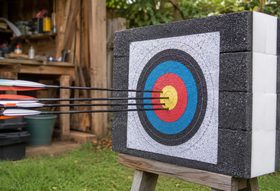
A layered foam target can be a useful low-cost project for controlled practice with a low-powered beginner bow. It should never be assumed safe for every bow, arrow or distance. Powerful compound bows, crossbows and damaged arrows can exceed the stopping ability of a homemade target.
Always shoot on a properly laid-out range with a safe overshoot area and backstop, following Archery GB guidance or the rules of your club.
Why use layered foam?
Dense resilient foam slows an arrow through friction as it passes between compressed layers. The target can be rotated and worn layers can be replaced, extending its useful life.
Closed-cell polyethylene or suitable EVA offcuts are more resistant to moisture than ordinary upholstery foam. Soft open-cell polyurethane tears more readily and shouldn't be relied upon for powerful equipment.
Important limitations
A target face is only one part of range safety. It doesn't replace a suitable backstop, secure shooting direction, clear control of the range and an area where nobody can enter unexpectedly.
Don't use a homemade target for broadheads, crossbows or high-powered compound bows unless a competent archery specialist has assessed the complete setup. For club, coaching or public use, choose purpose-made tested equipment.
Materials
For a simple low-powered target, use clean consistent strips or sheets of dense polyethylene or EVA foam, two strong timber end boards, threaded rods or heavy-duty compression straps, large washers and nuts, a target face and a stable stand.
Wear eye protection while cutting and drilling. Use tools appropriate to the material and keep hands clear of blades.
Choose a sensible target size
A face of roughly 600 mm square gives beginners a useful aiming area without making the unit excessively heavy. The final depth depends on foam, compression and bow energy, so there's no safe universal measurement. Plan a separate rated backstop behind the target before deciding where it will be used.
Cut equal foam layers
Cut the foam into strips or sheets of identical width. Uneven layers create gaps and weak areas. A sharp long knife can cut some foams with several controlled passes; denser material may need professional conversion. Don't heat unknown foam to cut it, as hazardous fumes may be produced. Our guide to cutting closed-cell foam covers safe methods.
Stack the layers
Place one end board beneath the stack and arrange the foam with edges aligned. Some designs place strips on edge so arrows enter between compressed layers; others use full sheets. Whichever arrangement is chosen, it must remain stable and uniform. Keep hard fixings outside the intended scoring area so an arrow can't strike metal.
Compress evenly
Fit the second board and tighten rods or straps gradually, alternating from side to side. Compression keeps the layers from separating, but crushing the foam completely can make arrows difficult to remove and damage the material.
Recheck all nuts, washers and straps. Cover exposed threaded ends so they can't cut the user during transport.
Fit a replaceable face
Attach a paper or fabric target face without placing hard fasteners in the central shooting area. A replaceable outer face helps keep the aiming marks clear while the foam behind continues to provide resistance. Don't wrap the entire target in a way that hides damage or traps water.
Build a stable stand
The target must not tip when struck or while arrows are removed. Use a broad timber stand suited to the target weight and ground conditions. Position it so missed arrows enter the backstop and safe overshoot area, never a fence, hedge or wall that people may be behind.
Test before normal use
Begin with the lowest-powered bow under close supervision, shooting one arrow into the centre. Check penetration from the side without standing behind the target. If the point approaches the rear, stop and improve the target or use a commercial one.
Test edge areas separately because they may be less compressed. Inspect after any change of bow, arrow or distance.
Maintenance
Rotate the target so wear is spread across the face. Replace torn or softened layers and tighten the compression system regularly. Store it dry and out of prolonged sunlight.
Pull arrows straight out one at a time while the shooting line is closed. Never allow anyone to collect arrows while another person is holding a bow on the line.
Sourcing foam
eFoam supplies closed-cell polyethylene foam and offcuts for many projects, but suitability for an archery target depends on the bow and complete range setup. Contact an archery specialist where stopping performance is uncertain, and use purpose-made targets for higher-powered equipment.
Frequently asked questions
Can you make an archery target out of foam?
Layered dense foam can make a useful low-cost target for controlled practice with a low-powered beginner bow, because the compressed layers slow an arrow through friction. It should never be assumed safe for every bow, arrow or distance – powerful compound bows, crossbows and damaged arrows can exceed the stopping ability of a homemade target.
What foam stops an arrow?
Dense, resilient closed-cell polyethylene or suitable EVA offcuts slow an arrow as it passes between compressed layers, and resist moisture better than ordinary upholstery foam. Soft open-cell polyurethane tears more readily and shouldn't be relied upon for powerful equipment.
Is a homemade archery target safe?
A target face is only one part of range safety. It doesn't replace a suitable backstop, a secure shooting direction, clear control of the range and an area nobody can enter unexpectedly. Always shoot on a properly laid-out range following Archery GB guidance or your club's rules, and use purpose-made tested targets for club, coaching or public use.
What should I avoid when making an archery target?
Don't use a homemade target for broadheads, crossbows or high-powered compound bows unless a competent archery specialist has assessed the complete setup. Don't heat unknown foam to cut it (hazardous fumes), don't place hard fixings in the shooting area, and don't position the target where missed arrows could reach a fence, hedge or wall that people may be behind.