





Key Foam Applications in the White Goods Industry
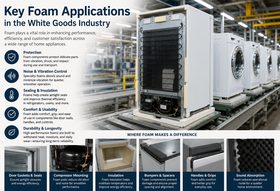
Washing machines, refrigerators, dishwashers and other large domestic appliances contain more foam components than most people realise. These parts may be hidden behind panels or fitted around pipework, but they help appliances operate quietly, efficiently and safely during transport.
The white goods industry uses several foam families because no single material can provide every required property.
What are white goods?
White goods are large household appliances such as refrigerators, freezers, washing machines, tumble dryers, dishwashers and cookers. The term dates from a period when many appliances had white enamel finishes, although modern products are available in many colours and materials.
Manufacturers need components that can be produced consistently, assembled quickly and perform for years in conditions that may include heat, moisture, detergent and vibration.
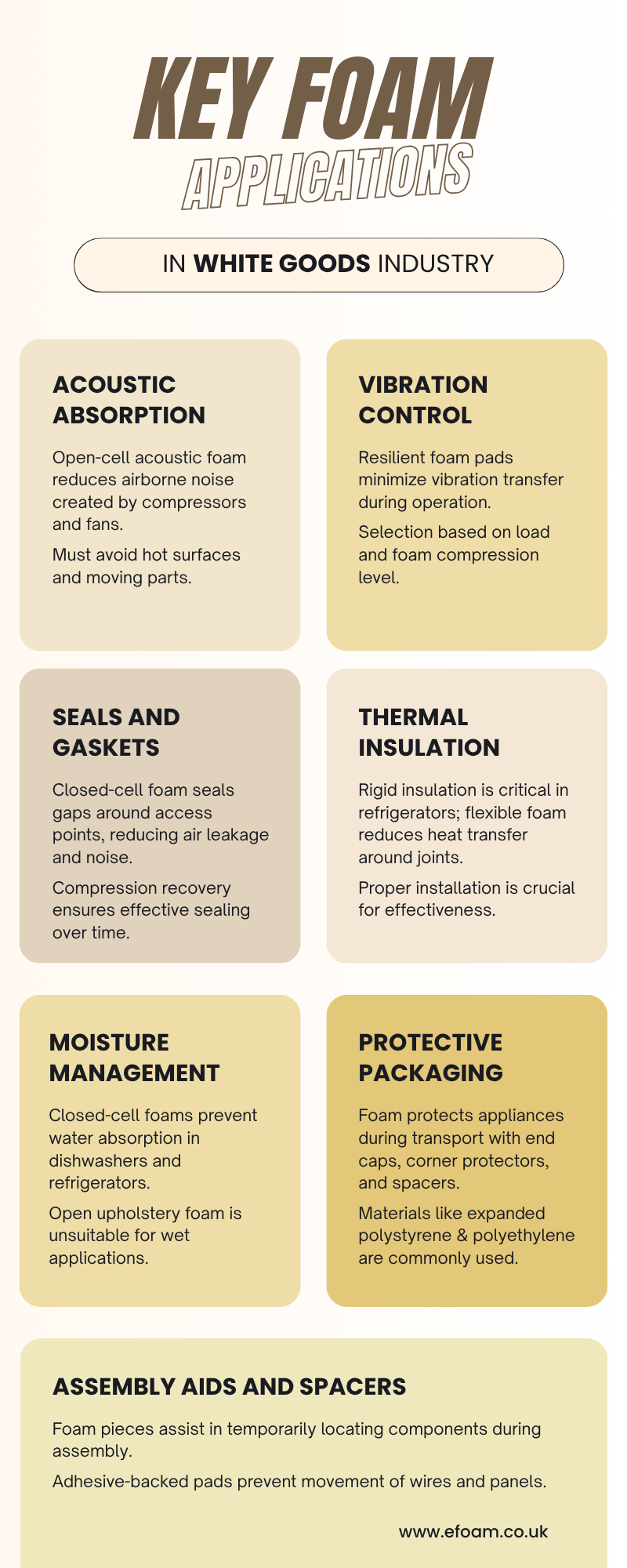
Acoustic absorption
Compressors, pumps, fans and moving drums create airborne noise inside an appliance cabinet. Open-cell acoustic foam can absorb reflected sound within suitable enclosures, reducing the build-up of reverberation.
The foam must be positioned away from moving parts and hot surfaces, and it must meet the fire and temperature requirements of the design. It works alongside, rather than instead of, structural sound barriers and vibration isolation.
Vibration control
A washing machine spin cycle or refrigerator compressor can transmit vibration into panels and floors. Resilient foam pads, seals and isolators can reduce contact between components, prevent rattles and limit vibration transfer.
Material selection depends on the load and how far the foam is compressed. A pad that's too soft may collapse, while one that's too firm may transmit vibration rather than isolate it.
Seals and gaskets
Closed-cell foam and flexible rubber foam are widely used to seal gaps around access panels, ducts, doors and service openings. A well-designed gasket can reduce air leakage, keep out dust and prevent two hard parts from rattling against each other.
Compression recovery is important. The gasket needs to maintain contact after repeated opening, closing and temperature cycling.
Thermal insulation
Refrigerators and freezers rely on rigid insulation within their cabinet structure. Flexible closed-cell foam may also be used around pipework, joints and service areas to reduce condensation and heat transfer.
The insulation system must be designed as a whole. Gaps and thermal bridges can undermine a high-performing material, so accurate cutting and installation are just as important as the foam specification.
Moisture management
Dishwashers, washing machines and refrigeration equipment all operate around water. Closed-cell materials are useful where low water absorption is required, while specially designed reticulated foam may be used in filtration or airflow applications.
Ordinary upholstery foam shouldn't be assumed suitable in a wet area. Its open structure readily absorbs water unless the application is specifically designed to drain and dry.
Protective packaging
Appliances must survive handling in warehouses, delivery vehicles and customers' homes. Foam end caps, corner protectors, pads and spacers prevent the product moving inside its carton and protect vulnerable surfaces from impact.
Expanded polystyrene is common in moulded high-volume packaging, while polyethylene and polyurethane foams are useful for specialist components, smaller production runs and delicate accessories. eFoam supplies packaging foam sheets and cut-to-size options for a wide range of products.
Assembly aids and spacers
Foam pieces can temporarily locate parts during assembly or transport. Adhesive-backed pads also prevent wires, pipes and panels from rubbing. These small components are inexpensive, but an unsuitable adhesive or foam can cause failures later, particularly where heat or plasticiser migration is involved.
Choosing foam for appliance manufacture
A useful specification should include operating temperature, exposure to moisture and chemicals, compression, fire performance, adhesive requirements, tolerances and expected production volume. Samples should be tested in the real assembly wherever possible.
For help comparing polyurethane, polyethylene, Plastazote, reconstituted and specialist grades, see our foam grades and datasheets or contact the eFoam team with your component requirements. You may also find our overview of foam in the automotive industry and foam fire-safety standards useful.
Frequently asked questions
What is foam used for in household appliances?
Foam supports several functions in white goods: acoustic absorption inside cabinets, vibration control under compressors and drums, seals and gaskets around panels and doors, thermal insulation in fridges and freezers, moisture management, protective transit packaging, and small assembly aids and spacers. No single material provides every property, so manufacturers use several foam families.
What foam is used in washing machines?
A washing machine may use open-cell acoustic foam for noise absorption, resilient foam pads and isolators for vibration control, and closed-cell foam or flexible rubber foam for seals and gaskets. Material choice depends on load, compression, temperature and exposure to water and detergent.
Can ordinary upholstery foam be used in wet appliance areas?
No. Ordinary open-cell upholstery foam readily absorbs water unless the application is specifically designed to drain and dry. Closed-cell materials are used where low water absorption is required, and specially designed reticulated foam may be used in filtration or airflow applications.
How do you choose foam for appliance manufacture?
A useful specification should include operating temperature, exposure to moisture and chemicals, compression, fire performance, adhesive requirements, tolerances and expected production volume. Samples should be tested in the real assembly wherever possible, rather than chosen on appearance.