





Foam for Foam Pits: Gymnastics, Trampoline Park and BMX Landing Pits
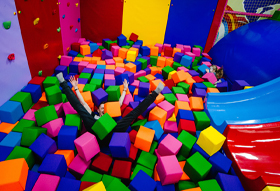
Available as foam block mats, blocks and cubes for trampoline parks, gymnasiums, extreme sports pits and parkour gyms
Use our FREE Gym Pit Foam Calculator to work out the exact quantity and cost for your pit in seconds — with free UK delivery included.
Foam is a versatile material, and in sporting environments it's lifesaving too. Commonly used in landing pits and crash mats in gymnasiums, these foams come in a range of specifications depending on the intended use, from BMX landing pits to the foam accessories found at trampoline parks.
Choosing the right foam grade
When buying gym pit foam, remember it comes in a range of grades, thicknesses and shapes — some better suited to certain applications. We supply four, and it is worth knowing that density and firmness are not the same thing. Two foams can share a density and land completely differently.
- Competition Grade (Blue) — SF38, 38 to 40 kg/m³, firm at 180 to 220 N. The densest gym pit foam on the UK market, where 33 kg/m³ is the usual maximum. Built for BMX, motorcycle and skate pits.
- Premium Grade (Pink) — SF33 ordered firm, 31.4 to 34.6 kg/m³, 175 to 210 N. Suited to trampoline parks and busy gymnastics clubs where the pit takes thousands of landings a week.
- Standard Grade (Green) — the same SF33 foam ordered softer, 31 to 34 kg/m³, 100 to 130 N. Same density as the Pink but more forgiving, which is why it is the usual choice for gymnastics clubs and leisure centres.
- Value Grade (Grey) — SF25/140, 22.8 to 25.2 kg/m³, 125 to 145 N. An entry-level option for community clubs, children's activity centres and lower frequency use.

It's also worth considering how daily versus occasional use affects the lifespan of foam cuts. Foam is durable, but a trampoline park pit used by the public can wear faster, as not everyone follows the rules. Choosing a denser, firmer grade — Competition Grade (Blue) for extreme sports and BMX, or Premium Grade (Pink) for a busy trampoline park — helps with this. Choosing the right foam is all about balancing comfort, safety and durability.
Building a foam pit
Pit fill comes as cubes or as foam logs. Cubes tumble and settle evenly, which suits gymnastics and trampoline park pits, while logs knit together and resist compacting, which suits deeper pits and BMX, motorcycle and skate landings. Many pits use a mix of both. In trampoline parks and gymnasiums, it's best to use large foam blocks such as 20cm (8-inch) cubes. These leave more space between cubes and so increase the foam's ability to absorb impact. There's more to a pit than the loose fill, though. Beneath it sit two layers doing two different jobs. First a thin closed-cell liner goes against the pit structure itself, protecting the walls and floor; many suppliers recommend flat mats of 1.25 inch, but for premium safety we'd use closed-cell polyethylene at least 2 inches thick. On top of that liner goes a base layer of open-cell sheet foam, typically 25 to 30cm (10 to 12 inches), which gives the pit its floor cushioning. We cut both to size. We also advise a pit at least 2 metres deep — no gymnast fancies hitting the bottom. Use our free calculator to work out exactly how many pieces you need. It works to a 70 per cent fill ratio, the accepted industry standard for loose pit fill, so enter the full depth of your pit and it does the rest.
Beyond trampoline blocks, there's rising demand for other shapes. For balance-pole battles – where players try to knock each other off a beam into a foam pit – you may want polyurethane foam cut to size and shape. From cylinder batons to triangle corner buffers for the edge of a pit, we supply an endless range of additional foam products.
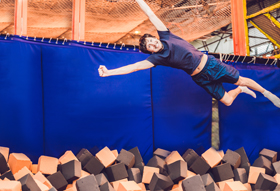
Foam for BMX and extreme sports
For extreme sports and high-impact activities, use a very high-density foam. Our Competition Grade (Blue) gym pit foam is cut from SF38 at 38 to 40 kg/m³, denser than anything else on the UK market, and firm at 180 to 220 N. It is specifically intended for BMX pits, motorcycle pits, skate parks and extreme sports facilities. This durable specialist foam survives wheels, handlebars and boards landing from speed and height, and gives a firmer landing better suited to protecting equipment while still absorbing impact well. The SF38 datasheet lists the full technical specification.
Block mats for gyms
Foam is also used in gymnasiums as mats. At eFoam we provide foam block mats made from high-density reconstituted foam, available in 1 inch or 2 inch thicknesses. Formed from foam offcuts compacted and bonded together, this foam is incredibly resilient and suitable for constant use, ideal for regular floor work and body conditioning, and designed to reduce strain on the body's pressure points. If you supply a club, our guide to foam for gymnastics covers training aids too.
Ready to order? Use our free gym pit foam calculator to work out exactly how many pieces you need and get an instant price with free UK delivery included. Alternatively, to discuss your requirements with an eFoam representative, please contact us.
Frequently asked questions
What size foam cubes should I use in a foam pit?
For trampoline parks and gymnasiums, large foam blocks such as 20cm (8-inch) cubes work best. The larger blocks leave more space between cubes, which increases the foam's ability to absorb impact.
How deep should a foam pit be?
We advise a working depth of at least 2 metres so no one hits the bottom. Beneath the loose fill a pit needs two layers: a thin closed-cell liner against the pit structure, for which we recommend closed-cell polyethylene at least 2 inches thick rather than the thinner 1.25 inch mats some suppliers suggest, and above that a base layer of open-cell sheet foam typically 25 to 30cm thick which provides the floor cushioning.
What foam is best for BMX and extreme sports pits?
A very high-density, firm foam is best for BMX pits, skate parks, motorcycle pits and extreme sports. Our Competition Grade (Blue) is cut from SF38 at 38 to 40 kg/m3 with a hardness of 180 to 220 N. It survives wheels, handlebars and boards landing at speed, gives a firmer landing and protects equipment while still absorbing impact.
What density should gym pit foam be?
Most UK gym pit foam tops out at 33 kg/m3. Our Competition Grade (Blue) is SF38 at 38 to 40 kg/m3, which is denser than any other gym pit foam on the UK market. Premium Grade (Pink) and Standard Grade (Green) are the same SF33 foam ordered to two firmnesses: 175 to 210 N for the Pink at 31.4 to 34.6 kg/m3, and 100 to 130 N for the Green at 31 to 34 kg/m3. Value Grade (Grey) is SF25/140 at 22.8 to 25.2 kg/m3 and 125 to 145 N.
How many foam cubes do I need for my pit?
Multiply the length, width and depth of your pit in metres, then allow 70 per cent of that volume in foam, which is the industry standard fill ratio for loose pit fill. Our free gym pit foam calculator does this for you and gives the exact number of pieces and the price, including VAT and free mainland UK delivery.