





Acoustic Foam for Office Sound Booths and Meeting Rooms

The COVID-19 pandemic affected us all in various ways, and it brought new ways of working. Where many companies once had dedicated offices with staff attending five days a week, meeting spaces rarely posed a problem. With the rise in remote and hybrid working, many companies have given up their office leases in favour of co-working spaces shared with other businesses. Some shared offices provide dedicated meeting rooms; many do not – so companies hiring an area within a co-working office often lack a suitable set-up for conference calls.
Working in a loud office is distracting when you're trying to talk on a call, and preventable background noise can be irritating and look unprofessional. There are two acoustic solutions for co-working offices: freestanding soundproof call booths, and customisable acoustic foam wall insulation added to the walls of a rented room.
Soundproof call booths
Individual soundproof call booths suit companies whose staff handle many calls at once. Even in the smallest spaces, these mini booths provide effective sound insulation to ensure privacy and minimise background noise. They're typically insulated with Pyrosorb-S Class 0 acoustic foam and include small bass traps in the corners to help control noise and reverberation.
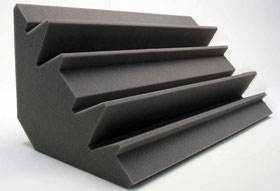
The acoustic foam lining the booth can be flat chamfered foam panels or convoluted "egg box" pieces. Choosing between them largely comes down to aesthetic preference and the space available inside the booth, so smaller booths may benefit from flat panels.
Acoustic foam for larger meeting rooms
To soundproof larger co-working spaces and meeting rooms for more privacy, acoustic foam panels can be ordered cut to size. They can also be ordered in the thickness needed to fit a wall cavity, or as individual panels for part of a wall. As a rule, panels 1 inch thick are recommended to dissipate human voices, and panels at least 2 inches thick to reduce the impact of music.
Reducing echo with sound-absorbing foam
To reduce echo within a booth or meeting room and keep speech clear, a different foam is needed: open-cell sound-absorbing foam. This minimises the noise blur caused by sound waves bouncing off hard surfaces, perimeter walls, ceilings and floors. Without it, booths and meeting rooms commonly suffer poor sound quality for in-person meetings, video calls and teleconferencing. If you'd like the basics of fitting it, see our guide to installing acoustic foam.
Please contact our knowledgeable team for personal guidance on the best soundproofing or sound-absorbing foam solution for your needs.
Frequently asked questions
How thick should acoustic foam be in an office?
It is recommended that acoustic panels around 1 inch thick are used to dissipate human voices, while panels at least 2 inches thick are better for reducing the impact of music.
What is the difference between soundproofing and sound absorption in an office?
Soundproofing foam such as Pyrosorb-S Class 0 blocks noise from passing in or out, while open-cell sound-absorbing foam reduces echo and blur inside the room by stopping sound waves bouncing off hard surfaces.
Can acoustic foam be cut to size for meeting room walls?
Yes. Acoustic foam panels can be ordered cut to size and in the thickness needed to fit a wall cavity, or as individual panels placed on part of a wall.