





The Ultimate Guide to Prop Making: Why TV & Film Productions Choose Foam
In film and television, props are fundamental to every programme, even when you don't notice them. They play a silent role in almost every scene, and given how many are used in a single hour of footage, they're typically "dummy" models – in other words, the sandwich on the kitchen counter in the background is probably made of foam, not bread.
Safety first: the use of foam in props
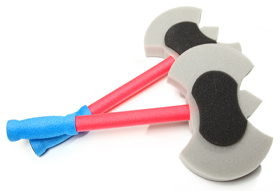
The same goes for props that would otherwise risk injuring actors or crew. Weapons in certain scenes are most likely not real but made of an incredibly high-density polyethylene foam that poses minimal risk. You might ask why not use a plastic axe – but moulded into the shape of an axe, knife or other sharp object, plastic can still cause accidental injury. Likewise, if a character had to lift an incredibly heavy set of weights, most actors would struggle while acting, so weight discs of high-density foam stand in for the real thing.
Props for special effects
Many productions use extra elements such as fire and water to reinforce a scene's impact, which can make some props a safety risk. Props that would normally be rubber, card or certain fabrics can be replaced with a foam equivalent for the same look. Using a fire-resistant or water-repellent foam, prop managers needn't worry about the item's resilience alongside special effects.
Complex and custom props
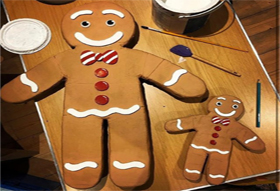
Beyond safety, foam is often used for complex or unusual props. As it can be easily carved or cut to size, it's useful for prop departments needing an item that can't be found in a prop room – that human-sized, alien-looking figure in your favourite film would otherwise be hard to source or very expensive to make from metal or plastic. Foam, by contrast, is easy to work with, paint and finish to the desired standard. Our customers at Dogfish Studios created amazing gingerbread-men props using high-density polyurethane foam sheets – see their work in the photo. Our guide to foam retail window displays shows similar prop work.
Lightweight props
Foam is also a good prop material in place of very heavy ones. As sets often move between locations, shifting heavy objects is time-consuming and impractical. That marble chair a character sits on can't be real marble, which would be heavy and costly – it's probably reinforced foam, likely a wooden chair structure surrounded by high-density foam shaped to look like marble, fully functional yet easy to move. For costume-based props, see our guide to cosplay foam.
eFoam expertise
eFoam is a specialist foam manufacturer and supplier with experience supplying professional film and television sets with foam props to production requirements. For detailed guidance, please contact one of our knowledgeable advisers, and follow our Instagram and X pages for more foam prop ideas.
Frequently asked questions
Why is foam used for film and TV props?
Many background props are foam "dummies" – the sandwich on the counter is probably foam, not bread. Foam also makes safer props, such as weapons and weight discs that pose minimal risk to actors, and it's easy to carve, cut and paint for custom items.
Are foam props safe with fire and water effects?
Yes. Where productions use fire or water, props that would normally be rubber, card or fabric can be replaced with a fire-resistant or water-repellent foam equivalent, so prop managers needn't worry about resilience alongside special effects.
What kinds of props are made from foam?
Background food, dummy weapons, weight discs, custom creatures and figures, and heavy-looking items like a marble chair (often a wooden frame surrounded by high-density foam) that needs to be light enough to move easily between locations.