





Foam Applications in the Military and Defence Industry
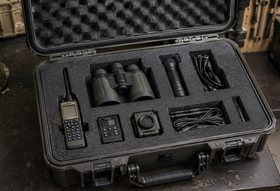
Foam may not be the first material that comes to mind when considering defence equipment, yet it appears in a wide range of supporting applications. It protects instruments in transit, reduces vibration, improves seating comfort and helps seal equipment against dust and moisture.
The important point is that "foam" isn't a single specification. Defence-related projects often demand tightly controlled density, fire performance, chemical resistance, traceability or dimensional accuracy, so the material must be selected around the actual operating conditions.
Protective cases and transport packaging
Sensitive equipment can be damaged by impact, vibration or movement inside a case. Custom-cut foam inserts hold items in a defined position and spread loads across a wider area. This is useful for communications equipment, optical devices, test instruments, medical kits and maintenance tools.
Closed-cell polyethylene and Plastazote are commonly considered for robust case interiors because they're firm, durable and resistant to water. Softer polyurethane may be added where delicate surfaces need gentle cushioning. Packaging foam cut to size allows the protection to be matched to the shape and weight of the equipment. For case interiors specifically, see our guide to custom foam inserts for cases.
Tool control and equipment organisation
Layered foam can be cut to create a clear location for every tool or component. A contrasting lower layer makes a missing item immediately visible, helping teams carry out quick checks before a case, vehicle or workshop kit is closed.
This type of organisation is valuable wherever accountability and speed matter. It also reduces contact between tools, helping to prevent scratches and impact damage during movement. Our guide to foam shadow boards explains the technique in detail.
Vehicle seating and crew comfort
Military and specialist vehicles may operate for long periods over uneven ground. Seating foam must provide support while coping with repeated loading, vibration and temperature changes. Different layers can be combined to balance comfort, pressure distribution and durability.
The correct grade depends on seat design, occupant load, thickness and applicable fire requirements. Density alone doesn't determine comfort, so prototype testing is often needed before a final specification is approved.
Vibration and impact management
Foam pads can isolate components from low-level vibration, cushion enclosures and protect assemblies during transport. Reconstituted foam is useful where a firm, load-bearing pad is required, while closed-cell materials may suit lighter cushioning and sealing tasks.
A foam should never be selected solely because it feels "shock absorbing" by hand. Engineers need to consider load, impact energy, compression, recovery and the frequency of vibration.
Sealing, insulation and environmental protection
Closed-cell foam can be used as a gasket or seal around panels, doors and equipment housings. It can help limit the entry of dust, reduce draughts and provide a thermal break. EPDM foam is another option where flexibility, weather resistance or sealing performance is required.
The design must account for compression over time. A seal that's crushed beyond its working range may take a permanent set and stop closing the gap effectively.
Marine and buoyancy uses
Low water absorption makes some closed-cell foams suitable for buoyancy blocks, flotation components and marine padding. Material choice must be based on the required buoyancy, water exposure, fuel or oil contact and any relevant certification.
Foam used around water should be distinguished from ordinary open-cell upholstery foam, which can absorb moisture and take a long time to dry.
Acoustic treatment
Machinery compartments and vehicle interiors can benefit from materials that absorb reflected sound. Open-cell acoustic foam is effective for reducing reverberation inside an enclosure, although it doesn't replace structural barriers, vibration isolation or hearing protection.
Where fire performance is critical, the specified acoustic product must be supported by appropriate test information rather than assumed to be suitable.
Choosing foam for a defence project
A useful specification should cover the application, dimensions, density or firmness, operating temperature, exposure to water and chemicals, fire requirements, tolerances and expected service life. Sample evaluation and controlled production records may also be necessary.
Our foam grades and datasheets provide a starting point for comparing materials. For specialist requirements, contact eFoam with the full specification so the proposed foam can be assessed against the job rather than chosen by appearance alone.
Frequently asked questions
What is foam used for in defence applications?
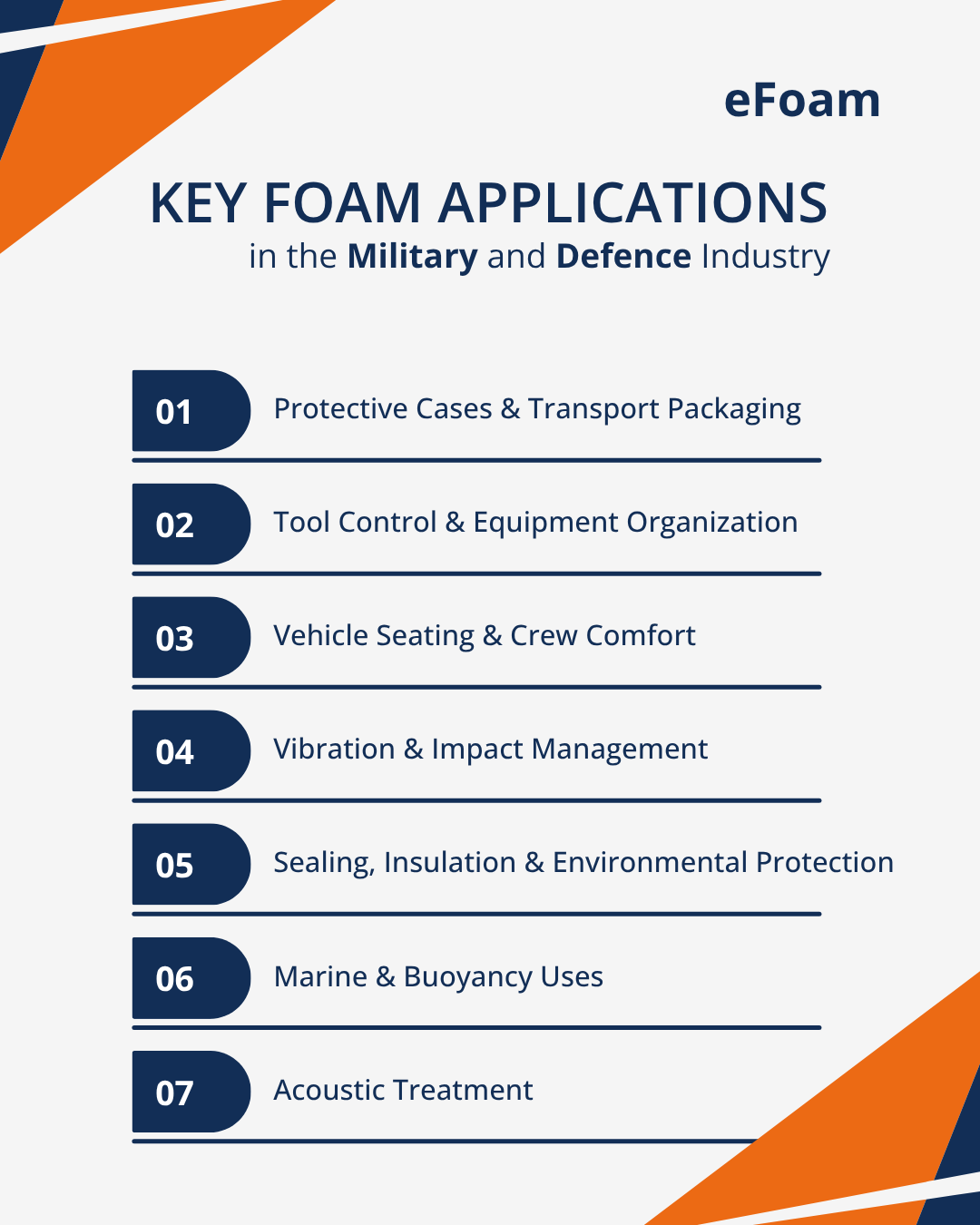
Specialist foam appears across many supporting roles: protective cases and transport packaging, tool control and equipment organisation, vehicle seating, vibration and impact management, sealing and environmental protection, buoyancy components, and acoustic treatment. "Foam" isn't a single specification, so each material is selected around the actual operating conditions.
What foam is best for protective equipment cases?
Closed-cell polyethylene and Plastazote are commonly considered for robust case interiors because they're firm, durable and water-resistant. Softer polyurethane may be added where delicate surfaces need gentle cushioning. Custom-cut inserts hold items in a defined position and spread loads across a wider area.
What is tool control foam?
Tool control (or shadow) foam is layered and cut so every tool or component has a clear location. A contrasting lower layer makes a missing item immediately visible, helping teams carry out quick checks before a case, vehicle or workshop kit is closed. It also reduces contact between tools, preventing scratches and impact damage.
Can foam be used for buoyancy?
Yes. Low water absorption makes some closed-cell foams suitable for buoyancy blocks, flotation components and marine padding. Material choice must be based on the required buoyancy, water exposure, fuel or oil contact and any relevant certification – and distinguished from ordinary open-cell upholstery foam, which absorbs moisture.