





Waterproof Expanding Foam: What You Need to Know
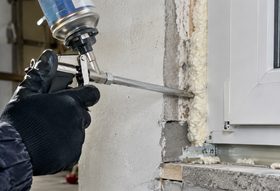
Expanding polyurethane foam is commonly used to fill gaps around frames, pipes and service penetrations. It's often described online as waterproof, but that word needs care. Some specialist products are formulated for damp or external conditions, while many general-purpose foams are only water-resistant once cured and still require protection.
Always follow the technical information for the exact can rather than assuming every expanding foam performs in the same way.
What is expanding foam?
Expanding foam is a reactive product dispensed as a liquid or froth. It expands and cures into a cellular polyurethane material, filling irregular gaps that would be difficult to pack with a rigid piece.
One-part aerosol foams cure with moisture from the air and surrounding surfaces. Professional two-part systems use separate chemical components. Both require careful handling, ventilation and personal protection in line with the manufacturer's instructions.
Is expanding foam waterproof?
Cured foam may resist occasional moisture, but many products aren't designed for permanent immersion or continuous water pressure. The cell structure, skin, density and exposure to sunlight all affect durability.
Cutting away the outer cured skin can expose a more porous interior. Outdoor foam may also degrade under ultraviolet light unless it's covered with a compatible sealant, trim or coating.
If an application must remain watertight, use a tested waterproofing system rather than relying on a generic gap filler.
Appropriate uses
Expanding foam can be useful for filling inaccessible voids around window and door frames, sealing gaps where services pass through a wall, and reducing draughts in protected areas. Low-expansion products are preferred around frames because excessive pressure can distort them.
Fire-rated foam is available for specific joint systems, but the complete installation must match the tested detail. A red or pink colour alone doesn't prove that a random application provides fire stopping.
Where it should not be used
Don't apply general-purpose foam around hot flues, chimneys or equipment beyond its temperature rating. It shouldn't block ventilation openings, weep holes or drainage paths.
Avoid using it as an exposed structural repair or as the sole means of stopping an active water leak. It's also difficult to remove cleanly once cured, so think about future access to pipes, cables and fixings.
Spray foam applied broadly to roof timbers is a different system from a small can of gap filler. Loft installations require independent assessment because moisture, inspection and property-valuation issues may arise if the work is unsuitable or poorly documented – we cover this in our article on spray foam in lofts.
Safe application
Read the safety data and product instructions before use. Wear the recommended gloves and eye protection, ventilate the area and protect nearby finishes. Uncured polyurethane foam is extremely sticky and shouldn't contact skin.
Apply in controlled layers, allowing for expansion. Overfilling wastes material and can place pressure on surrounding components. Keep ignition sources away and follow the disposal instructions for the container.
Alternatives to expanding foam
A shaped closed-cell foam strip may be better where a joint needs controlled compression, clean removal or repeated movement. EPDM foam is commonly used for seals and gaskets, while polyethylene foam can form a water-resistant thermal break or packing piece.
For larger flat areas, a sheet product gives predictable thickness and avoids uncontrolled expansion. eFoam supplies closed-cell polyethylene foam and Plastazote sheets cut to size.
Flexible sealants are more appropriate for narrow moving joints, while cementitious or specialist waterproofing products are needed where there's water pressure. For more on working with rigid foams, see our guide to foam in construction.
Choosing the right product
Check whether the application is internal or external, the size of the gap, movement, temperature, fire requirement and degree of water exposure. Look for explicit statements in the datasheet, such as suitability for permanent immersion, rather than relying on a retailer's headline.
Where a clean, removable or accurately sized foam component is needed, contact eFoam with the dimensions and environment. Expanding foam is useful, but it's only one option and not always the most suitable one.
Frequently asked questions
Is expanding foam actually waterproof?
Be careful with that word. Some specialist products are formulated for damp or external conditions, but many general-purpose foams are only water-resistant once cured and still need protection. Cured foam may resist occasional moisture, yet many products aren't designed for permanent immersion or continuous water pressure. Always follow the datasheet for the exact can.
Where should you not use expanding foam?
Don't apply general-purpose foam around hot flues, chimneys or equipment beyond its temperature rating, and never block ventilation openings, weep holes or drainage paths. Avoid using it as an exposed structural repair or as the sole means of stopping an active water leak, and remember it's difficult to remove cleanly once cured.
What can I use instead of expanding foam?
A shaped closed-cell foam strip is often better where a joint needs controlled compression, clean removal or repeated movement. EPDM foam suits seals and gaskets, polyethylene foam can form a water-resistant thermal break, and for larger flat areas a sheet product gives predictable thickness without uncontrolled expansion. Flexible sealants suit narrow moving joints.
Is expanding foam safe to use?
Read the safety data and product instructions first. Wear the recommended gloves and eye protection, ventilate the area and protect nearby finishes. Uncured polyurethane foam is extremely sticky and shouldn't contact skin. Apply in controlled layers, keep ignition sources away and follow the disposal instructions for the container.