





Acoustic Interior Trends for Modern Workspaces
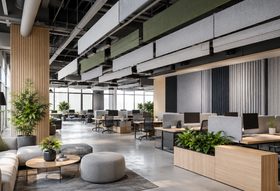
A well-designed workplace should look good, but it also needs to sound comfortable. Hard floors, glass partitions and open ceilings may create a clean modern appearance, yet they can also allow voices, phone calls and equipment noise to travel across the room.
That's why acoustics now forms part of interior planning rather than being treated as a final correction. The most successful workspaces balance sound absorption, privacy, collaboration and visual design from the beginning.
What is acoustic interior design?
Acoustic interior design considers how sound behaves within a space. It looks at the room's size and shape, the amount of hard reflective surface, the position of people and equipment, and the activities taking place.
The aim isn't to make an office silent. A completely dead room can feel unnatural. Instead, designers control reverberation and prevent unnecessary sound from dominating areas where people need to concentrate or communicate.
Why workplace acoustics matter
Poor acoustics can make speech difficult to understand in meeting rooms and too easy to overhear in open offices. People may raise their voices to compete with the background noise, creating a cycle in which the room becomes steadily louder.
A considered acoustic scheme helps create different conditions for different tasks. Collaborative areas can remain lively, while focus rooms and call spaces feel calmer and more private. See also our guide to reducing noise in the workplace.
The role of materials
Soft, porous materials absorb part of the sound energy that reaches them. Upholstered seating, curtains, carpet, ceiling rafts and acoustic wall panels all contribute. Open-cell acoustic foam is particularly useful because sound can enter its cellular structure rather than being reflected straight back into the room.
Absorption is only one part of the design. Privacy between enclosed rooms may also require solid partitions, sealed doors and attention to ventilation paths. Acoustic foam improves sound within a room; it doesn't replace a properly constructed sound-insulating wall.
Trend 1: acoustic zoning
Modern offices increasingly divide space by activity rather than relying on one large open plan. Quiet zones, touchdown areas, collaboration spaces and phone booths each receive a different acoustic treatment.
Zoning may use furniture, screens and ceiling treatments to interrupt sound paths. Placing noisy functions such as printers, kitchens and informal meeting points away from focused workstations can be more effective than adding panels after the layout is complete.
Trend 2: integrated acoustic features
Acoustic products no longer need to look like technical add-ons. Wall panels can be arranged as artwork, ceiling baffles can define circulation routes and upholstered screens can provide both visual separation and absorption.
Flat or profiled acoustic foam panels can be used behind fabric finishes, inside joinery or as part of a deliberate geometric design. Where the foam will remain visible, neat alignment and consistent spacing are important.
Trend 3: biophilic and natural-looking design
Biophilic design brings natural forms, textures and planting into the workplace. Acoustic elements are increasingly shaped to complement this approach, using leaf-like profiles, muted colours and layered surfaces.
Plants can make a space feel calmer and may scatter a small amount of sound, but they shouldn't be relied upon as the main acoustic treatment. Purpose-made absorbent surfaces are still needed where reverberation is a problem.
Trend 4: greater acoustic privacy
Video calls and confidential conversations have increased demand for small rooms, booths and screened areas. These spaces need both internal absorption and adequate sound insulation.
Inside a booth, absorbent foam or fabric-covered panels reduce the boxy sound caused by close parallel surfaces. Around the booth, sealed construction prevents speech escaping through doors, glazing joints and service openings. Our guide to office sound booth foam covers this in detail.
Trend 5: adaptable treatment
Workplaces change frequently, so removable and modular acoustic products are becoming more useful. Panels can be repositioned as teams move or the layout changes. This is more flexible than relying entirely on fixed finishes.
Self-adhesive products are convenient, but the wall finish and future removal should be considered. Mechanical fixing or removable frames may be more appropriate in leased premises.
Trend 6: responsible material selection
Designers are paying closer attention to durability, repairability and manufacturing waste. A product that lasts, can be replaced in sections and is cut efficiently may offer better long-term value than a disposable decorative solution.
Fire performance is also essential, particularly in commercial and public buildings. Use a product with documentation suitable for the project rather than assuming all acoustic foams meet the same standard.
Planning an acoustic workspace
Start by identifying the actual problem: excessive reverberation, poor speech clarity, lack of privacy or noise passing between rooms. Each requires a different response. Measure the space, note the reflective surfaces and prioritise the areas where people spend the most time. For a deeper look at fault-finding, see our guide to common acoustic problems and foam for offices.
For help choosing material and thickness, explore eFoam's acoustic foam range or contact us with the room dimensions and intended use.
Frequently asked questions
How do you improve the acoustics of an office?
Identify the actual problem first – excessive reverberation, poor speech clarity, lack of privacy or noise between rooms – because each needs a different response. Add soft, porous materials such as upholstered seating, carpet, ceiling rafts and acoustic wall panels to absorb sound, prioritising the areas where people spend the most time.
Does acoustic foam soundproof an office?
No. Acoustic foam improves sound within a room by absorbing reflections; it doesn't replace a properly constructed sound-insulating wall. Privacy between enclosed rooms also requires solid partitions, sealed doors and attention to ventilation paths.
What is acoustic zoning?
Acoustic zoning divides a workspace by activity rather than relying on one large open plan. Quiet zones, touchdown areas, collaboration spaces and phone booths each receive different treatment, using furniture, screens and ceiling products to interrupt sound paths. Placing printers, kitchens and informal meeting points away from focused workstations is often more effective than adding panels afterwards.
Can plants improve office acoustics?
Plants can make a space feel calmer and may scatter a small amount of sound, but they shouldn't be relied upon as the main acoustic treatment. Purpose-made absorbent surfaces are still needed wherever reverberation is a problem.